Fruit and vegetables are often the least visible loss in a kitchen budget. Meat and cheese are weighed and tracked, but how much of a crate of parsley or tomatoes ends up in the bin rarely appears in anyone's records. Yet cutting waste can save far more than haggling over price. In this guide we explain where waste happens, how to measure it, how to work out the true cost and the practical steps you can take to reduce it.
Where does waste happen?
Produce waste does not happen at one point but throughout the product's journey through the kitchen. Separating four main stages lets you fix the problem in the right place:
- Delivery and storage waste: produce kept at the wrong temperature, bruised or held in storage longer than necessary.
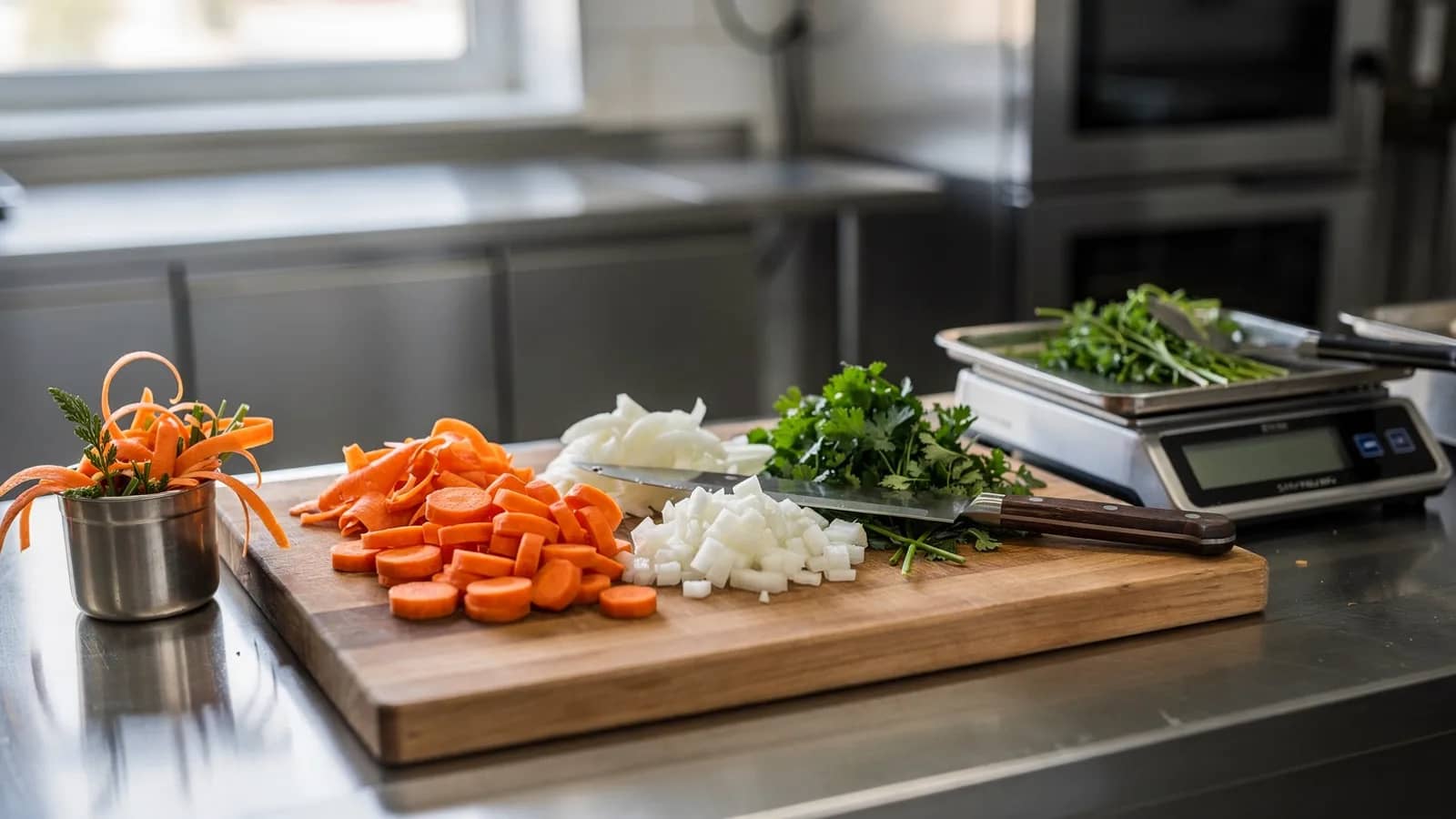
- Prep waste: peel, seeds, stems, outer leaves and trimmings. Some is unavoidable; some can be reduced through technique and habit.
- Over-preparation: produce chopped for service, not used and unable to last until the next day.
- Plate waste: what guests leave because of portion size or garnish choices.
Yield: not every kilo you buy gets used
Yield shows how much of the purchased weight becomes usable. The calculation is simple:
Yield = usable weight ÷ purchased weight
For example, if you buy 10 kg and get 8 kg of usable produce after cleaning and cutting, your yield is 80%. Peel on root vegetables, stems and leaves on cauliflower and broccoli, the green part of leeks, and peel and seeds on fruit all lower yield. Yield varies with product, size, ripeness and prep method, so the most accurate figure is the one you measure in your own kitchen.
Work out the true cost
The price per kilo on the price list is not the cost of what reaches the plate. To find the true cost, divide the price per kilo by the yield:
Cost per usable kilo = price per kilo ÷ yield
Of two products with the same price per kilo, the one with the lower yield costs more per usable kilo. The same calculation helps with choosing sizes: a cheaper product in small, irregular sizes can produce more waste when peeled and cut. Costing recipes with this true cost also makes menu pricing accurate.
You can't manage what you don't measure: the waste log
The first step in cutting waste is making it visible. Keeping a simple waste log for two to four weeks is enough:
- Date and product: what was thrown away and when?
- Quantity: weighed, or counted in crates, bunches or pieces.
- Reason: spoiled, prep trimmings, over-prepared, plate waste.
- Stage: storage, prep, service.
After a few weeks the picture usually becomes clear: in most kitchens the bulk of waste comes from a handful of products and reasons. Focusing effort on those products gives the fastest results.
Practical steps to cut waste
When ordering
- Set par levels: define for each product the quantity that lasts until the next delivery, and order "up to par".
- Buy perishables often: order herbs and soft fruit little and often, hardy produce less frequently.
- Ask for ripeness by day of use: specify produce for immediate use separately from produce that will wait a few days. See our wholesale buying guide for details.
In storage
- The right zone: place every product according to its temperature and humidity needs, and separate ethylene-producing fruit from sensitive produce.
- FIFO: put new deliveries behind old ones and write the delivery date on crates.
- Daily checks: pull out produce that is starting to spoil and send it for use straight away. Storage details are in our cold chain guide.
During prep
- Standard cuts: define for the team how each product is cleaned and cut; peeling and trimming too thickly quietly increases waste.
- A daily prep list: decide how much to cut based on bookings and past sales, and limit "just in case" prep.
- Sharp knives and the right equipment: they bring both speed and yield.
On the menu
- Cross-utilisation: using the same product in several dishes keeps stock moving.
- Use trimmings: stems and peels make stocks, overripe tomatoes make sauce, wilted greens make soup. Our article on herbs has more ideas.
- Review portions: garnishes that keep coming back half-eaten suggest the portion can be smaller.
- Work with the season: seasonal produce arrives fresher, lasts longer and produces less waste.
Handling unavoidable waste properly
The inedible part — peel, seeds and spoiled produce — never disappears completely. Collecting it separately as organic waste allows it to be handled through composting or municipal organic waste schemes. For surplus produce that is still fit to eat but will not be used, organisations running food banks can be an option.
A small starter plan
- Week 1: start the waste log and explain the reason to the team.
- Weeks 2–3: identify the five products with the most waste and measure the yield of each.
- Week 4: update the order quantity, frequency and storage place for those products.
- After that: keep the waste log for one week a month to track progress.
Ordering the right quantity is the easiest way to cut waste. On our fruit and vegetable lists you can see every product's sale unit and gather what you need in one cart.