For October wholesale pear sourcing, professional kitchens should buy by intended use, receive fruit at the right maturity, separate cold holding from ripening, and issue only the quantity each service period can use. This approach gives restaurants, hotels, caterers, offices, and institutions dependable texture while reducing bruising, over-ripening, trim loss, and avoidable disposal.
Plan October pear orders around the menu
Start with covers, portions, preparation style, and the dates on which pears must be ready. A breakfast buffet, conference refreshment station, plated dessert, and production kitchen do not need the same ripeness profile. Divide the order into fruit for immediate preparation, fruit for the next few days, and firmer stock for later service. This makes ripening a scheduled production task rather than a last-minute problem.
The wholesale pear selection should be the core order. Add apples for mixed fruit service or quince for cooked autumn menus when the kitchen needs several textures and preparation options from one seasonal order.
Match pear types to kitchen use
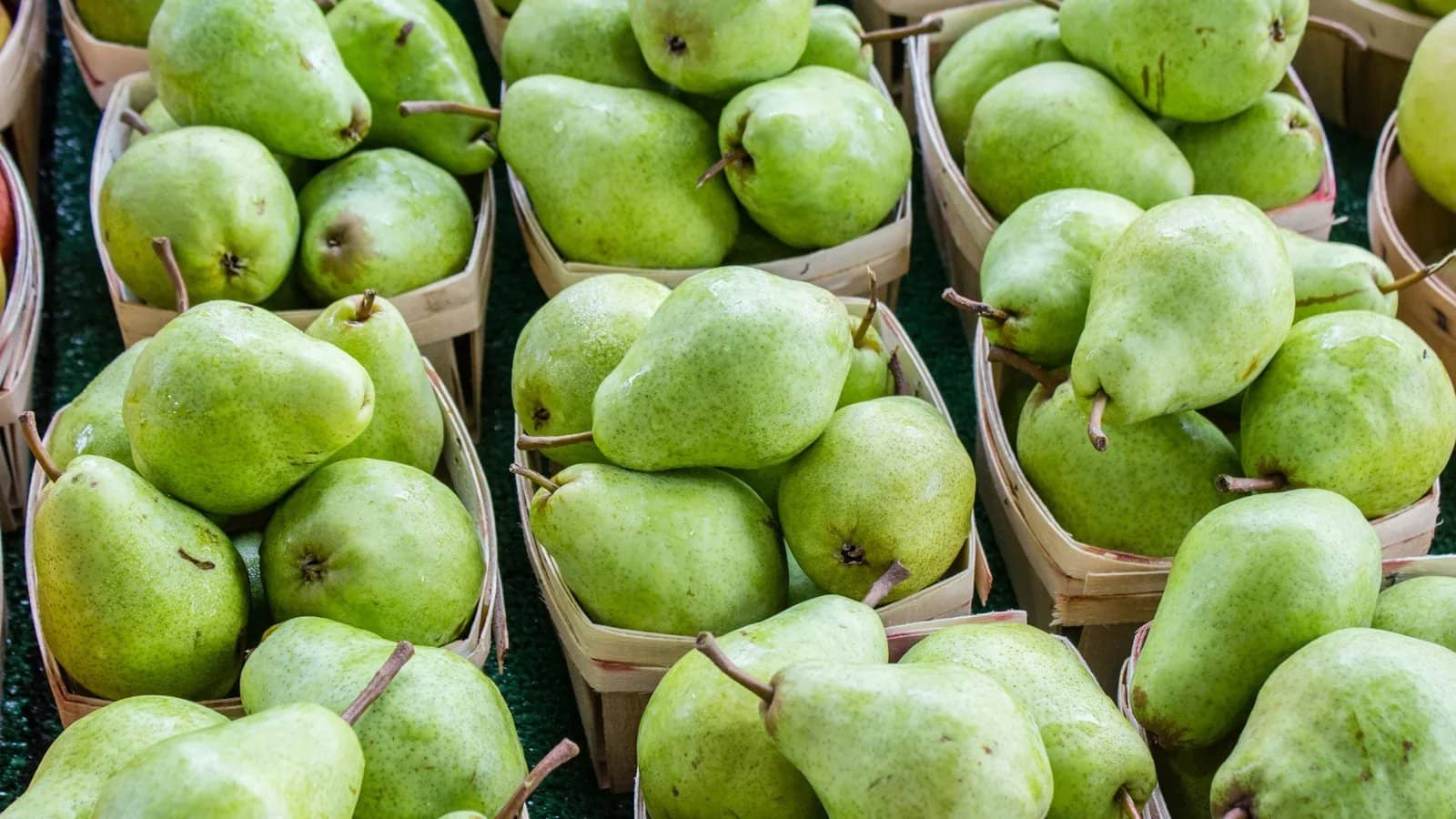
Bartlett pears are useful when the team wants a juicy, aromatic pear with a buttery texture at eating ripeness. UC Davis identifies sweet taste, pleasant aroma, juiciness, and buttery texture as desired qualities, and notes that Bartlett performs best when harvested mature-green and ripened off the tree. For foodservice teams, that makes firm incoming fruit suitable for controlled ripening before slicing, breakfast service, desserts, or purée preparation.
October availability may also include Concorde, Green Anjou, Red Anjou, and Winter Nelis, while Bosc, Comice, Forelle, Seckel, and other types may be relevant depending on supply. Oregon State Extension lists Concorde, both Anjou colors, and Winter Nelis with September–October harvest timing. It also explains that skin color is not equally useful across varieties: Bartlett, D’Anjou, and Comice lighten as they mature, while Bosc does not show the same change.
Choose a uniform lot when consistent plate appearance and ripening speed matter.
Use firmer fruit for cutting schedules that require handling before service.
Reserve fruit that yields gently at the neck for near-term fresh service.
Direct cosmetically imperfect but sound fruit to cooked or blended preparations, subject to the kitchen’s quality standards.
Build a disciplined receiving check
Inspect pears as soon as the delivery arrives and record the result by lot. UC Davis quality indicators include shape, size, and freedom from insect damage, decay, mechanical injury, and other defects. Check cartons across the delivery rather than judging only the top layer. Look for cuts, punctures, compression, rubbing, decay, and flesh damage suggested by impact.
Handle every carton gently. UC Davis notes that impact bruising produces brown flesh discoloration and becomes more severe as drop height increases. Partially ripe and ripe pears are more susceptible than mature-green fruit. Vibration can also cause brown skin spots or bands. Keep pears immobilized during internal movement, avoid drops onto prep tables, and do not stack in ways that compress fruit.
Receiving checklist
Confirm variety, quantity, lot identity, and intended service window.
Assess firmness and visible color consistently across sampled cartons.
Reject or isolate fruit showing decay, serious wounds, or unacceptable damage.
Separate ripe, ripening, and firm fruit before storage.
Send bruised or damaged but usable fruit to prompt evaluation; Oregon State advises that damaged fruit is not suitable for storage and should be used quickly.
Control ripening instead of guessing
Most pears should not be expected to reach their best quality on the tree. Oregon State explains that they ripen from the core outward and from the neck toward the calyx; pears left to ripen on the tree can become coarse and mealy, with core breakdown. For a simple readiness check, apply light thumb pressure at the stem end. A ripe pear yields gently at the neck. Bartlett also changes from green toward a lighter yellow-green as it ripens, but many other varieties show little dramatic color change.
Keep a dated ripening area and inspect fruit daily. Oregon State advises moving pears from cold storage to room conditions of 60–70°F for three to ten days before eating. The exact service point should be chosen for the recipe: fruit for hand service can be allowed to yield gently at the neck, while a kitchen that needs clean slices may issue it earlier. Do not assume every variety behaves like Bartlett.
Store cold stock correctly
For commercial Bartlett handling, UC Davis gives an optimum temperature of -1 to 0°C and optimum relative humidity of 90–95%. Those values describe commercial postharvest conditions; kitchens should use monitored equipment capable of safely maintaining their chosen specification. Prompt cooling and temperature maintenance help limit quality loss. Oregon State likewise emphasizes temperature control, clean ventilated boxes, air circulation, and avoiding storage of bruised or diseased fruit.
Do not wash pears before storage. Oregon State states that extra moisture can hasten decay. Keep storage containers clean and ventilated, use unsealed or perforated bags where appropriate, and inspect stock so spoiled fruit does not remain with sound fruit. Rotate by received date, ripeness, and condition rather than date alone.
Protect yield and reduce pear waste
Yield management begins before the knife. Set a standard edible portion, measure actual trim for each preparation, and compare issued quantity with portions served. Record losses under useful causes such as receiving damage, storage decay, over-ripeness, excessive trim, or unused prepared fruit. The record tells the buyer whether to adjust order size, delivery frequency, ripening batches, or menu allocation.
Move the ripest sound pears to the earliest service.
Prepare smaller batches for buffets and replenish as demand develops.
Use suitable soft fruit promptly in purées, sauces, compotes, or baked applications.
Keep damaged fruit away from storage stock and evaluate it under food-safety and quality procedures.
Review the practical guide to reducing fruit and vegetable waste in restaurants.
For broader seasonal planning, see autumn fruits for professional menus. When quantities and delivery timing are set, build your October pear order in the English cart for your restaurant, hotel, catering operation, office, or institution.